
PILOT INTERFACE GUIDELINES
Overview
The focus of this research was to analyze the user interface experience for pilots and determine market segmentation.
My Role
Senior UX Designer
UX domains
Problem
The Human Factors team lacked domain knowledge in Aerospace. The business had no clear vision for pilot-facing interfaces. Aerospace itself is vast—with outdated systems and many user types—making it hard to define a path forward.
Strategy | Research | Plan
Duration
6 Months
Approach
Our 4-member team conducted foundational research to map the Aerospace ecosystem and define a future vision for pilot UI. We identified the right market segments and unmet needs, giving the HF team a solid springboard for further development.
Research
Understanding all the stakeholders
We created an initial stakeholder map as a basis for gathering a more comprehensive understanding of the stakeholders involved.
Why a Stakeholder Map?
-
Establish shared ideas about the users
-
Identify and document their needs and goals
-
Direct user research
-
Identify holes and opportunities
-
Unify the development team
-
Bring new team members up to speed quickly
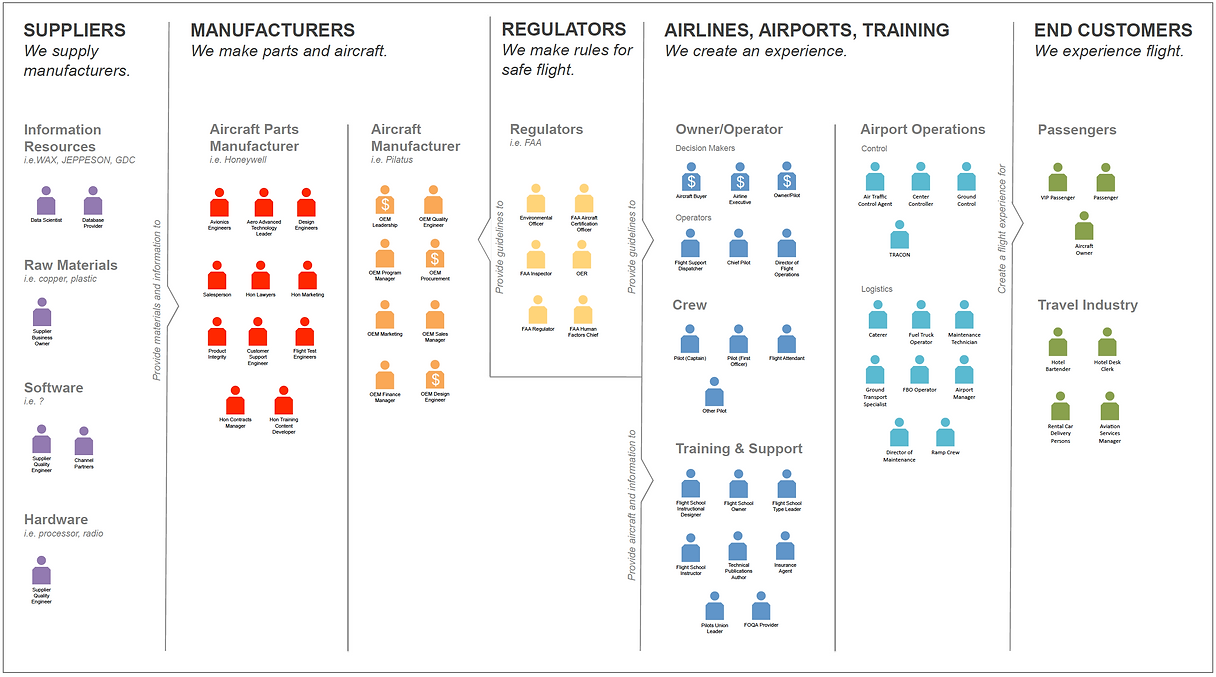
This map is a result of several revisions. We gained a richer understanding of the business and the people involved.
Observational and interview research with Aerospace
As part of our OVOC work, we conducted interviews with multiple individuals. We utilized a stakeholder map to recruit our participants. Our primary resources consisted of an Engine Flight Test Pilot, a Flight Safety Instructor, Maintenance Technicians, and Simulator Instructors. Our secondary resources included Honeywell Informants and Cockpit Confidential.
Approach
During our research phase, we conducted interviews and observations with a select group of individuals who were able to provide us with their time. This allowed us to gain valuable insights and experience directly from pilots in the field. In a second phase, we focused on those who make purchasing decisions for avionics.
Focus
Our main focus was to comprehend the various Pilot Information Systems and how pilots interact with the information provided. As newcomers to the aerospace industry, we also needed to grasp the fundamentals of both the business and flight.
Goal
Our objective in conducting research was to gather sufficient data to create an initial information architecture and obtain insights into the user interface design endeavors.


Analysis and Synthesis
We read through the notes and all the additional things we remember. Organized our thinking about what we learnt. Asked ourselves :
-
What did we see that was surprising?
-
What stood out as new?
-
What was validated?
-
Where could a better solution have made for a better user experience?


Sharing the result
Pilot UI Guiding Principles
These five principles, which emerged from our research, represent themes that were intended to help guide the design of the next pilot user interface.
-
Shared the synthesized results with our team.
-
Stated some new hypothesis from what we learned.
-
Identified additional questions and next steps for our self and the team.
Design for a Connected World
Pilots are exposed to and manage multiple converging information systems.
The Plane Should Know the Pilot
The pilot knows the ins and outs of the plane, but the aircraft doesn’t know the pilot, and he must start fresh for each flight.
Where it is - is what it is
Every flight deck is laid out using the same template, we find the same things in the same places across different aircraft.
Extend Redundancy to Increase Safety
Information is repeated everywhere, because redundancy is
critical to safety.
Leverage the Passion, Elevate the Expertise
The feel of flying drives a pilot’s passion for flight. Pilots have deep expertise in the physics and mathematics of flight.
Structuring the information
We considered data objects as the primary components of our Information Architecture. In other words, you can think of these as individual actors within a domain. In the domain of flying and the flight deck, the primary actors are: OPERATOR(S)
An operator is responsible for monitoring and controlling the aircraft. He/she is actively involved in flying an aircraft and is the primary user of a flight deck.
AIRPLANE
An airplane is the machine used for flight. The airplane has a state that describes the number, type, position, and status of all parts of the airplane. The state of the airplane also drives position.
FLIGHT COURSE
Flight course information describes where the operator intends to move the craft (the plan), the path the airplane takes (the actual), when, and how.
POSITION
Airplane position describes where it is relative to the earth.
ATMOSPHERE
Atmosphere describes the properties of the complex and dynamic airspace above the earth through which the aircraft must travel.
EARTH
Earth is the land surface of the world that contains points of departure and landing facilities for an airplane.

Information Flow

Current Flow
In the current information system, pilots are relied upon to receive and integrate information from multiple sources. The information they get comes from Operations or Data Centers, air traffic controllers via radio and email (or paper/fax). They must synthesize this information in their heads, notate it in pencil, then input key portions of it into the avionics system by hand.

Future Flow
In the future, the avionics system could be a centralized hub that integrates information from multiple sources, presenting it to the pilot in various appropriate ways. Pilots are still leading the decision making about what action to take on the information and they control the final execution of that action. Alternately we could consider a pilotless flight deck, where those two seats are filled by VIP guest observers, and the avionics do all the flying.
Information from Technology
Information could take the form of video, audio, info displays, switches/buttons, lights
There are 6 valuable aspects to consider as we reimagine a future user experience. Each aspect approaches the experience at a slightly different angle, but together they will allow us to think about the user experience holistically and provide a structure for thinking about possible information sources.

Road mapping a Future Pilot User Interface
An advanced vision about the long range future of pilot user interfaces must be grounded in both today’s reality, and some hypothesis about the future. Five key areas affecting avionics design are mapped out below. This was a good exercise which helped us make claims about the Pilot User Interface.

Outcome - Future Pilot User Interface
Based on our work understanding the current pilot user interface, making claims about the future and following the guiding principles we drafted, we created this sketch of a future pilot user interface concept.

Here are the details of our achievements in implementing the UI principles mentioned earlier.
Design for a connected world

In this concept, the avionics system accepts and synthesizes all incoming information
from other systems. We could consider a pilotless flight deck, where those two seats are filled by VIP guest observers, and the avionics do all the flying.
The plane should know the pilot

Here the avionics system recognizes the pilot as he boards, and takes sensor readings on his health. The system is also able to go to his preset preferences. In this case, the pilot must do validation but not data entry to prepare the aircraft for flight.
Where it is - is what it is

Reflecting back to the underlying template of current flight decks, we built upon this map of the space. The sketch maintains position of the basic information groupings from the current flight deck experience.